Why Pavers Work Well on the Coast
Concrete pavers cover a lot of the outdoor jobs around a Coast home: the path down the side, the patio out the back, the pool surround, the courtyard between the house and the studio. They are pre-cast concrete units laid over a prepared base, and they earn their place here for a few practical reasons.
The first is how they handle movement. Down on the Peninsula sand at Umina and Ettalong, or on the reactive clay behind Gosford and Kincumber, the ground shifts a little with the weather. One large slab has to crack somewhere to cope with that, but a paved area is made of many small units with joints between them, so it flexes with minor ground movement instead of cracking across the middle. If a section ever does settle, individual pavers can be lifted and relaid rather than cutting into a slab.
The second is the surface. Pavers come in textured and honed finishes that give grip when wet, which is exactly what you want around a pool at Terrigal or Avoca or on a path that catches beach spray. The third is salt. Quality concrete pavers are dense and made for outdoor use, so they cope with the salt-laden air near the water, and because you seal the surface and the joints you keep salt, weeds and staining under control. For a lot of Coast homes a paved patio or pool surround is the sensible middle ground between a plain slab and natural stone.
Getting Pavers Laid Right
The base is everything
Pavers are only ever as good as what they sit on, and this is where jobs succeed or fail. For most paths and patios the crew excavates, lays and compacts a road-base sub-layer, then a bedding layer that the pavers sit in. The whole build is set to falls so water runs away from the house rather than pooling, which matters more on the low ground near Brisbane Water and the lakes where drainage is already a challenge.
On loose Peninsula sand the base has to be properly confined and compacted, and edge restraints hold the whole area together so pavers do not creep and open up gaps over time. Skip the base prep and pavers rock, sink and lift within a year, no matter how good the pavers themselves are.
Laying, cutting and finishing
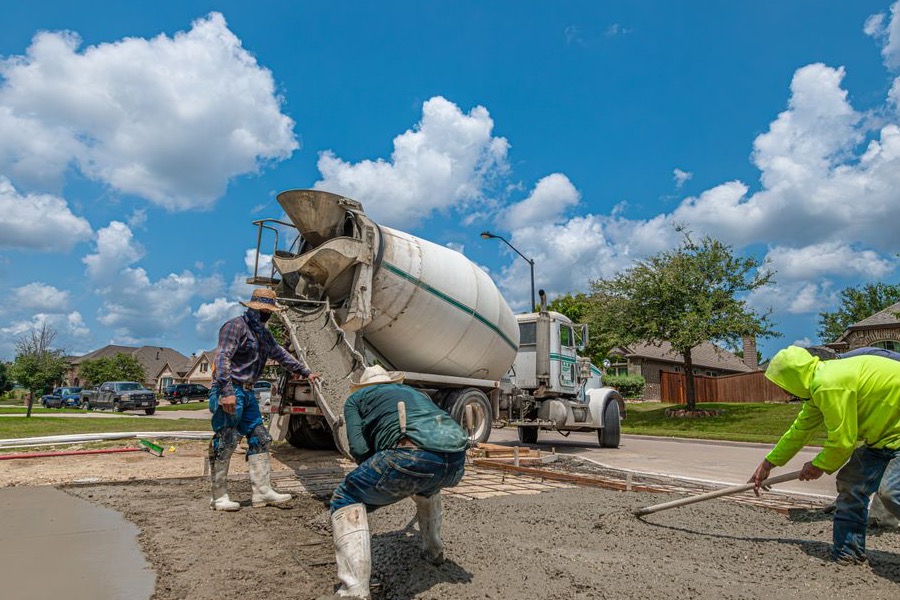
The pavers are set out in the pattern you have chosen, cut cleanly around edges, drains and the pool coping, and levelled as they go. For a pool surround the fall and the drainage detailing around the coping matter, because water has to move away from the pool edge properly. Once laid, the joints are filled, usually with a jointing sand or a polymeric jointing compound that locks the sand in place, resists weeds and copes with hosing down. A sealer over the top then protects the pavers and the joints from salt, sun and pool chemicals, and it gets refreshed every few years.
For a pool surround or a courtyard where you want a continuous poured look instead of individual units, exposed aggregate or decorative concrete are worth comparing. A local concreter can walk you through which suits your space and how the two compare on upkeep.
Pavers or a Poured Slab
Both have their place, and the right one depends on the area and how you want it to look:
- Pavers suit areas where you want individual units you can lift and relay, a specific paver look, or a surface that flexes with minor ground movement. They are handy on the sandy Peninsula and around pools.
- A poured surface suits larger areas where you want a seamless finish, a driveway carrying vehicle loads, or a floor you will polish. Exposed aggregate and decorative concrete give you texture and colour in one continuous pour.
- Upkeep differs. Pavers need the joints kept up and the odd weed managed; a sealed poured surface has no joints to maintain but shows any cracking as one piece.
If you are weighing it up, tell us about the space and what you want out of it, and we will get a concreter or paver out who can lay either and give you a straight comparison. Every paving job needs a look at the ground, the falls and the access before it can be priced.
Related Concreting
Exposed Aggregate
A seamless poured surround with grip and character. .
Exposed aggregate →Decorative
Colour and pattern in a continuous pour. .
Decorative concrete →Driveways
Vehicle areas that need a full slab. .
Concrete driveways →Local crews
Paving across the Coast, including Woy Woy and The Entrance.